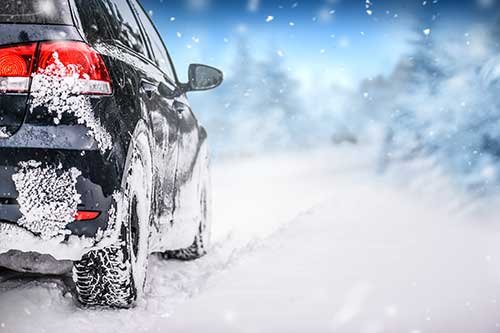



Even in the best conditions, winter driving takes preparation, patience, and flexibility. And that goes double for driving in Colorado’s mountains, where road and weather conditions can change rapidly and present a series of formidable challenges for even the most seasoned driver, from fog and windy whiteouts to ice storms, slush, and passes closed by avalanches.
A new traction law that went into effect this year should help to make mountain driving along the state’s busiest corridor a bit safer. But the law is only effective if people know about and comply with its requirements. Whether you’re heading for the ski resorts or just trying to get home for the holidays, here’s what you need to know about the new law — and a few tips that can make your mountain journey that much more enjoyable.
WHAT IS COLORADO’S TRACTION LAW FOR PASSENGER VEHICLES?
The Colorado Department of Transportation has long had the authority to require that certain vehicles carry special traction equipment, such as tire chains, during weather emergencies. What’s different about Colorado’s new traction law, which went into effect in August 2019, is that it imposes a season-long requirement for drivers heading into the mountains along I-70, from Dotsero to Morrison. From September 1 through May 31, drivers using this 126-mile stretch of interstate are required to have either snow tires, tires designated for mud and snow (“M+S” tires), or four-wheel or all-wheel drive vehicles. In addition, the minimum amount of tread required for tires on snowy roads across the state is now 3/16 of an inch, up from a previous 1/8-inch requirement.
What’s behind the new law? A desire to get motorists using only two-wheel drive vehicles to improve their traction with snow-worthy tires or chains, while also keeping the four-wheelers from thinking they’re so well-equipped that they can get away with bald tires.
During severe storms, CDOT can still require passenger vehicles to put on chains, just like the big rigs. And the penalty for ignoring such requirements can be steep, from a basic fine of $130 for ignoring traction requirements to one of more than $650 if a motorist without sufficient traction gets stuck and blocks the roadway.
KEEPING SAFE ON MOUNTAIN ROADS
Although mountain driving can have its anxious moments, you can reduce your risk of an accident or getting stranded by following a few common-sense principles. The most important:
THE CAR ACCIDENT ATTORNEYS AT FDAZAR
For more than thirty years the attorneys at Frank Azar Car & Truck Accident Lawyers have helped thousands of injured people obtain complete and timely compensation for their losses. Our proven track record and expertise have allowed us to grow into the largest personal-injury law firm in Colorado, with offices in Denver, Aurora, Thornton, Fort Collins, Greeley, Grand Junction, Colorado Springs, and Pueblo. If you’ve been injured in a bus, car, truck, or motorcycle accident, you may be entitled to compensation. Please call the car accident attorneys at FDAzar day or night at 720-372-2824 or contact us here for a free consultation and no-obligation evaluation of your case.